
ITCHING, FLAKING, BURNING OR BUILDUP?
Stop guessing what your scalp needs.
Whether your scalp feels itchy, flaky, oily, dry, tight, tender, inflamed or simply “not right,” you do not need to know the diagnosis before asking for help. Tell us what you are experiencing and we will guide you toward the most appropriate next step.
✓ Approximately 15 minutes ✓ Virtual first step ✓ Private and no obligation

You do not need the right medical words.
Describe what you feel, what you see and what you have already tried. That is enough to begin.
Assessment first
Clarity before a product or plan
Begin virtually from anywhere
Free 15-minute starting point
Personalized guidance
No one-size-fits-all protocol
Grande Prairie and Peace Country
1,000+ people supported
START WITH WHAT YOU NOTICE
Your scalp should not be a daily distraction.
Scalp concerns do not always arrive with a clear diagnosis. Start with the symptom that is interrupting your comfort, confidence or routine.

Flaking or scaling
White, yellow, greasy or dry flakes appearing in the hair, along the hairline or on clothing.

Persistent itching
An itch that returns after washing, increases at certain times or becomes difficult to ignore.

Dryness or tightness
A rough, dehydrated or uncomfortable scalp that may feel tight soon after washing.

Redness or inflammation
Visible irritation, discolouration, swelling or areas that feel warm and sensitive.

Burning or tenderness
A scalp that feels painful, hot, tight, tingling or unusually sensitive—even with limited visible change.

Bumps, sores or crusting
Small raised areas, pustules, scabs or recurring spots that may be itchy, sore or difficult to heal.

Excess oil or buildup
Roots that quickly become greasy, waxy or coated, sometimes with visible residue around follicles.

Shedding or breakage
More hair coming out, visible thinning or shorter broken hairs occurring alongside scalp symptoms.
THE THREE CLUES THAT MATTER
You do not need the condition name. Start with the pattern.
These three clues help organize what may need to be investigated—without asking you to diagnose yourself.
1
What do you see?
Fine flakes, greasy scale, redness, plaques, residue, bumps, crusting or no obvious visible change.
2
What do you feel?
Itching, burning, stinging, tightness, tenderness, pain or sensitivity when touching or styling the hair.
3
What is your hair doing?
Shedding, thinning, breaking, forming patches—or remaining unchanged while the scalp symptoms continue.
THE REAL PROBLEM

Similar symptoms can require different next steps.
Flaking, itching and redness are clues—not a complete diagnosis.
You have probably tried enough products already.
When every shampoo, oil and online recommendation offers a different explanation, it is easy to mistake temporary symptom control for solving the underlying problem.
✓ Anti-dandruff shampoos
✓ Scalp oils and serums
✓ Home remedies
✓ Clarifying products
✓ Salon scalp treatments
✓ Changing wash frequency
The difficulty is not a lack of effort. Different scalp concerns can look and feel similar. A product that makes sense for one pattern may dry, irritate or mask another.
The first step should not be another guess. It should be greater clarity.
SCALP SYMPTOMS AND HAIR CHANGES
Is the scalp problem causing the hair loss?
Sometimes the scalp contributes. Sometimes the thinning is a separate issue. Often both arrive at the same time which is why Restore considers the scalp and the hair pattern together.
What guessing often looks like
Persistent scratching or forcefully removing scale can break hairs and, in some conditions, contribute to temporary hair loss.
Some scalp disorders require medical treatment
Infection, psoriasis, eczema and inflammatory or scarring disorders may need a physician or dermatologist—not another cosmetic product.
Thinning may be a separate hair-loss pattern
A widening part, receding hairline or thinning crown can coexist with scalp discomfort. Clearing the flakes does not automatically address that separate pattern.
General education only. The free assessment helps determine whether Restore’s full analysis or medical evaluation is the appropriate next step.
MEET THE GUIDE
You do not have to diagnose your own scalp.
Restore helps people make sense of hair and scalp concerns through an assessment-first process that is clear, respectful and personalized.
1
We begin with your experience.
What you feel, what you see, when it started and what makes it better or worse.
2
We look for the pattern.
Location, duration, triggers, product history and whether shedding or breakage is also present.
3
We recommend the right level of care.
That may be a full scalp analysis, personalized care or referral to a medical professional.
YOUR SAFEST STARTING POINT
Free Scalp Assessment
A short private conversation with a Hair Recovery Advisor before you commit to a product, treatment or full consultation.
✓ Explain your symptoms in your own words
✓ Review what you have already tried
✓ Discuss the most appropriate next assessment
✓ Ask questions about the process and costs
YOUR PATH FORWARD
Three steps from scalp discomfort to a clear plan.
No self-diagnosis. No generic protocol. Just a structured path based on what your scalp and hair actually need.
01
Start with your free assessment
Get clarity on the best next step.
Speak privately with a Hair Recovery Advisor about your symptoms, how long they have been happening and what you have tried.
02
Examine what may be driving it
Understand the pattern before treatment.
Speak privately with a Hair Recovery Advisor about your symptoms, how long they have been happening and what you have tried.
03
Receive personalized guidance
Know what to do and why it matters.
Receive recommendations appropriate for your findings, routine and goals—including medical referral when that is the responsible next step.
WHY ASSESSMENT MATTERS
One symptom can point to several different concerns.
Itching, scaling, redness and discomfort can appear in multiple scalp conditions. The images below are educational examples—not a tool for self-diagnosis.
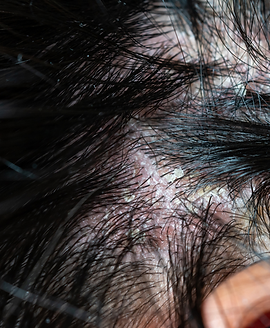
Residue and buildup
Oil, dead skin and product residue may create irritation or visible coating around the follicles.
Can resemble: dandruff, oil imbalance or dermatitis.

Psoriasis-like scaling
Thicker, defined or silvery scale should be medically evaluated before selecting supportive scalp care.
Can resemble: severe seborrheic dermatitis.

Dermatitis patterns
Redness, oiliness and recurring flakes may have several possible causes that can resemble one another.
Can resemble: dandruff, eczema, psoriasis or product irritation.

Inflammation and irritation
Tenderness, burning or visible redness may call for deeper scalp analysis or medical assessment.
May occur with: irritation, infection, inflammatory disease or nerve-related sensitivity.
Important:
Restore’s free assessment is not a medical diagnosis. Conditions such as psoriasis, eczema, infection and scarring disorders may require diagnosis and treatment by a physician or dermatologist.
CHOOSE THE RIGHT KIND OF HELP
A relaxing scalp service and a scalp-health assessment solve different problems.
If your goal is relaxation and cleansing, a reputable head spa may be appropriate. If symptoms keep returning or hair changes are involved, you need a process designed to investigate the pattern and determine the correct next step.
Head spa or salon scalp service | Restore’s assessment-first process | |
|---|---|---|
Medical concerns | Medical referral is recommended when diagnosis or prescription care may be required. | Should be referred out by a responsible provider. |
Hair changes | Shedding, thinning and breakage are considered alongside the scalp concern. | Usually outside the main purpose of the service. |
Starting point | Begin with history, symptom pattern and what has already been tried. | Select a service or products for the appointment. |
Primary purpose | Understand the symptoms and determine what should happen next. | Relaxation, cleansing and a restorative experience. |
Simple rule: choose a head spa when your scalp is healthy and you want it cared for. Choose an assessment-first clinic when something feels wrong, keeps recurring or is changing your hair.
WHAT YOU ARE ACTUALLY BOOKING
Two different appointments. Two different purposes.
The free assessment is the low-pressure starting point. Magnified examination and treatment planning happen only if a full Hair and Scalp Analysis is the appropriate next step.
15-Minute Scalp Assessment
With a Hair Recovery Advisor · Virtual first step · No obligation
The safest place to start if you're not sure what you're dealing with yet — or if you've never spoken to a trichology-trained clinic before.
✓ Describe what you see and feel in your own words
✓ Review the timeline, triggers and areas affected.
✓ Discuss products, prescriptions and remedies already tried.
✓ Identify whether a full analysis, simple guidance or medical referral may be appropriate.
✓ Ask initial questions about Restore’s process, options and costs.
90-Minute Hair & Scalp Analysis
With a trichologist · Currently $200 · Detailed examination
The safest place to start if you're not sure what you're dealing with yet — or if you've never spoken to a trichology-trained clinic before.
✓ Magnified examination of the scalp, follicles and hair.
✓ Detailed review of scalp symptoms, shedding, thinning or breakage.
✓ Assessment of routines, history and relevant contributing factors.
✓ Clear explanation of findings and remaining uncertainties.
✓ Personalized recommendations, monitoring plan or medical referral.
WHEN MEDICAL CARE SHOULD COME FIRST
Some scalp symptoms should not wait for a clinic assessment.
Contact a physician, dermatologist or urgent-care provider when you experience:
-
A rapidly spreading or severe rash
-
Significant swelling or severe pain.
-
Fever or feeling systemically unwell
-
Pus, drainage or signs of infection
-
Open, bleeding or non-healing sores
-
Sudden patches of hair loss
-
Smooth, shiny or visibly scarred areas
-
A changing growth, mole or persistent lesion
General scalp-health education on this page is aligned with public guidance from the American Academy of Dermatology regarding itchy scalp, dandruff, scalp psoriasis, hair-loss warning signs and when a rash may require medical attention.
QUESTIONS BEFORE YOU START
Clear answers reduce uncertainty.
Here is what most people want to know before speaking with Restore.

FREE SCALP ASSESSMENT
You have tried enough guesses. Start with a clearer next step.
Tell us what you see, what you feel and what your hair is doing. Restore will help determine whether you need a full scalp analysis, a different kind of professional or a simpler change at home.
✓ Approximately 15 minutes ✓ Virtual first step ✓ Private and respectful ✓ No obligation